
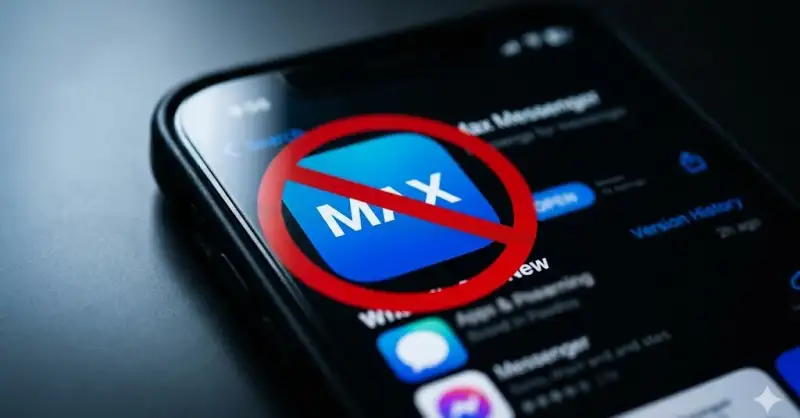
Apple has removed Russia's state-backed messenger Max from the App Store, cutting off new downloads for millions of iPhone users without offering any public explanation. The app, developed by VK and heavily promoted by the Kremlin as a sovereign alternative to Western messaging platforms, disappeared from Apple's marketplace on June 3, 2026, at approximately 9:00 p.m. Moscow time.
What Is Max and Why It Matters
Max is a super-app launched by VK in spring 2025. Modeled loosely on China's WeChat, it bundles messaging, social networking, digital identity, payments, banking, and government services into a single platform. Russian authorities have aggressively pushed the app as a domestic substitute for foreign alternatives: since September 2025, Max has been preinstalled on every new smartphone sold in Russia. Its rise accelerated in February 2026, when Russian authorities blocked WhatsApp for most users, leaving Max as the officially sanctioned option for hundreds of millions of people.
The removal is the second strike against VK-connected apps by Apple in recent months. In early April 2026, Apple pulled Telega - another VK-linked messaging application - following similar concerns about its security practices. Max's disappearance now leaves Russian iPhone users unable to install fresh copies or update existing installations through the App Store.
No Explanation From Apple
Apple did not issue a public statement and did not respond to press requests for comment as of publication. The company gave no reason for the removal, leaving both Russian users and VK without official clarity on the decision.
VK confirmed the takedown and advised users to open the app manually to check for messages, since push notifications for calls and messages have also been disabled on iPhones. The company said it is "seeking clarification from Apple to resolve the issue promptly." In a separate development, Russian Digital Development Minister Maksut Shadayev publicly accused Apple of restricting access for more than 20 million Russian iPhone users without explanation, calling the move unjustified.
Spyware Concerns Preceded the Move
The removal comes against a backdrop of mounting technical evidence about Max's surveillance capabilities. Independent security researchers who analyzed Max's source code documented more than a dozen hidden mechanisms embedded in the application:
- Remote microphone recording: The app contains functionality that allows audio capture without explicit user action.
- Contact list harvesting: User contact data is exfiltrated to external servers.
- VPN detection: The app actively identifies when a user is routing traffic through a VPN.
- Silent message deletion: Messages can be deleted from a user's device without their knowledge or consent.
In late April 2026, Cloudflare flagged the Max domain as malicious spyware based on detected security flaws. The designation was lifted on May 1 after VK complained, with the company attributing the warning to a "misreading of request headers sent to ordinary web analytics services." Security researchers disputed that explanation, pointing to the breadth of the documented capabilities as evidence of deliberate design rather than accidental header behavior.
Political Pressure in the Background
The removal also follows a public campaign by Yulia Navalnaya, who in February 2026 specifically lobbied Apple and Google to remove Max from their platforms, framing it as a censorship and surveillance tool. While there is no confirmation that this campaign directly influenced Apple's decision, the timing aligns with a period of heightened international scrutiny of Russian state-linked applications.
The FSB, Russia's federal security service, has accused Western content delivery networks including Cloudflare and Fastly of facilitating foreign intelligence surveillance - an accusation that mirrors, in reverse, the concerns raised about Max's own technical infrastructure.
What Happens Next for Russian iPhone Users
For Russians who already have Max installed, daily functionality remains intact for now. However, the notification blackout creates a significant usability gap: users must manually open the app to check for new activity, which undermines the core purpose of a messaging platform. VK has directed Android users to download the app directly via APK from its own website as a workaround. iPhone users, however, have no equivalent option: Apple's strict app ecosystem prevents sideloading in Russia, leaving iOS users effectively locked out of new installs with no easy alternative path.
The episode highlights the increasingly fractured state of Russia's digital infrastructure. With WhatsApp blocked and Telegram operating in a legal grey zone, Russian authorities have staked enormous political capital on Max as the centerpiece of their sovereign internet strategy. Its removal from the world's second-largest app distribution platform is a significant setback, regardless of whether Apple acted on security grounds, regulatory pressure, or a combination of both.
For the tens of millions of Russians who use iPhones and now find themselves in a messaging dead zone, the gap between officially mandated platforms and freely accessible communication tools has never been wider. Independent tools for bypassing network restrictions continue to see record demand inside Russia as the digital landscape narrows further.
• Apple Removes Kremlin-Backed Messaging App Max From App Store - The Moscow Times
• Apple Removes Russian State-Backed Max Messenger Amid Spyware Questions - UNITED24 Media
• Russia's state-backed messaging app Max vanishes from App Store - Meduza
• Russia's State-Sanctioned Max Messenger Removed From Apple's App Store - Kyiv Post